Updated: January 12, 2026
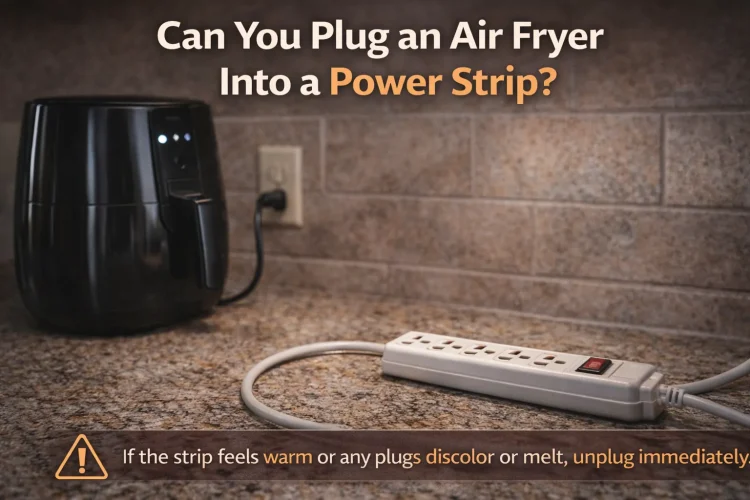
If your kitchen has limited outlets, it’s tempting to plug an air fryer into a power strip and move on with your day. Sometimes it “works” for months… until one day the strip feels warm, the plug looks slightly discolored, or the air fryer shuts off mid-cook.
Here’s the honest answer
you can sometimes plug an air fryer into a power strip. But it’s often a bad idea—and some manufacturers explicitly say not to use extension cords (which includes most strips). The safest setup is still a direct wall outlet.
Safety note (read first)
If you smell something burning (not food). See a hot plug or cord, notice flickering power, hear crackling sounds. Or find melting or discoloration on the strip or outlet, stop right away, unplug everything, and let it cool down. Electrical heat is not something to ignore.
Air Fryer Turns On by Itself: What It Means, Safe Fixes, and When to Unplug for Good
FAQ: Plugging an Air Fryer Into a Power Strip
Is it safe to plug an air fryer into a power strip?
Sometimes, but it depends on your air fryer instructions and the strip’s rating/quality. Many air fryers are high-wattage appliances, and many strips are not meant for that kind of continuous load.
What if the power strip says “Max 2500W” or “16A”?
That’s a good sign, but it’s not the whole story. Real-world heat often comes from weak contacts, thin internal parts, long use at high load. Or adding other devices to the same strip.
Is a surge protector better than a normal power strip?
A surge protector can protect electronics from voltage spikes, but it does not magically make high-wattage loads safer. The overload risk still depends on current, heat, and contact quality.
Can I plug only the air fryer into the strip (nothing else)?
That’s the only scenario that even has a chance of being reasonable. And only if the strip is properly rated and your air fryer manual doesn’t forbid it.
Are extension cords safer than power strips for an air fryer?
Not automatically. Many extension cords are undersized or left coiled, which can heat up. Also, many air fryer manuals discourage extension cords entirely.
Why does my air fryer trip the strip breaker (or the wall breaker)?
Usually because the circuit is overloaded, the strip is low-quality, or the air fryer is sharing power with other devices. Sometimes it’s a sign of a loose outlet or a failing strip.
Is it okay to use a smart plug adapter with an air fryer?
Often not recommended for high-wattage appliances. Extra adapters add contact points—and contact points are where heat builds.
What’s the safest alternative if my outlet is far away?
Move the air fryer to a wall outlet that’s closer. Avoid running it under cabinets, and if you truly need a new outlet where you cook. The best long-term fix is adding an outlet by a qualified electrician.
Air Fryer Timer Not Working: Stuck, Not Counting Down, or Ends Early (Safe Fixes)
60 Second Mini-Check: Is Your Power Strip Setup Risky?

Before you plug an air fryer into a power strip, do this quick check. If you hit any “No,” don’t use the strip.
- Label check: Does the strip show an amp/watt rating and safety marks?
- Single-use check: Will the air fryer be the only device on the strip?
- Heat check: Is the strip cool around the sockets and cord entry?
- Cable check: Is the strip cord thick and undamaged?
- Placement check: Is the strip in open air (not under rugs or appliances)?
- Outlet check: Does the wall outlet grip the plug firmly?
If any part of this feels questionable, it usually is
Air Fryer Error Codes Explained (E1/E2/E3/E4): Safe Fixes + When to Contact Support
What Actually Happens When You Plug an Air Fryer Into a Power Strip
An air fryer is basically a strong heating element plus a fan. Heating elements draw a lot of power for sustained periods, especially during preheat and when the temperature cycles.
When you plug an air fryer into a power strip, three practical things can change:
The strip becomes a “hot spot” risk
Even when the strip is technically rated high enough, the weakest point is often the contact pressure inside the strip. Weak contacts create resistance, and resistance creates heat. That heat builds slowly—so it can look fine at first.
The margin disappears when you add “one more thing”
This is how most people get in trouble. The air fryer might be fine alone, but then a kettle, toaster, microwave, or coffee maker gets added. “just for a minute.” High-wattage appliances stack fast.
Mini example: The air fryer is running, and you plug in a kettle on the same strip. Nothing explodes—yet. But the strip heats at the sockets, and that’s when melted plastic smells show up.
Coiled cords and cramped spaces trap heat
If the strip cord is coiled or wedged behind something, it can’t shed heat well. Heat that would normally dissipate stays trapped, so temperatures rise faster.
Air Fryer Plug Gets Hot: Is It Normal? Safe Checks!
When It’s Usually NOT a Good Idea to Plug an Air Fryer Into a Power Strip

If you want a simple rule you can trust: avoid using a power strip for an air fryer. Unless you have a very good reason and a very good strip. In these situations, it’s a “no.”
Your air fryer manual says “do not use extension cords”
Many manuals explicitly say this. If yours does, treat it as a hard stop. A power strip is effectively an extension cord plus extra sockets.
The strip is cheap, old, unbranded, or feels flimsy
Low-cost strips often have weaker internal contacts. Also, older strips can loosen with time—even if they look fine outside.
The strip is already powering anything else
Air fryers don’t mix well on a strip with other heat appliances or motor loads.
The strip is hidden, covered, or squeezed
Under rugs, behind cabinets, under stacked items, or inside a cabinet: all bad. Heat needs air.
Your outlet feels loose or the plug sits “halfway”
Loose outlets cause arcing and heat. A strip won’t fix that; it can make it worse because you now have more connections.
Air Fryer Won’t Turn On (No Lights, No Power): A Simple Reset + Safety Checklist
If You Absolutely Must Plug an Air Fryer Into a Power Strip
Sometimes people have a genuine layout problem. If you truly must plug an air fryer into a power strip, make it a “best possible version” of a not-ideal setup:
Use a strip that’s built for higher loads
Look for:
- A clear amp and watt rating
- A built-in overload breaker
- A thick cord (with a sturdy plug)
- A reputable brand with safety markings
Important: “Surge protected” is not the same as “safe for high continuous heat loads.” Surge protection helps with spikes, not with overheating contacts.
Use the strip for the air fryer only (during cooking)
No “also charging my phone.” No “just the toaster for a second.” Keep the strip dedicated while the air fryer runs.
Keep everything uncoiled and in open air
Uncoil the cord fully. Place the strip where it can breathe. Don’t tuck it behind the air fryer, and don’t let it rest against hot surfaces.
Plug the strip directly into the wall (no chaining)
Never plug a strip into another strip. Never plug a strip into a lightweight extension cord. Those extra connections are heat points.
Keep the air fryer’s own cord relaxed
1: Don’t pull it tight. 2: Don’t crush it under the air fryer. 3: Don’t pinch it in drawers or cabinet doors.
If this is a daily problem, solve it properly
If you need this setup regularly, the safest long-term “fix” is not buying a fancier strip. It’s adding an outlet where you cook.
Common pattern (E-E-A-T line)
When power strips fail with an air fryer, it’s usually not the air fryer. The problem is the strip slowly heating at the socket contacts. This happens after repeated high-load cooking sessions.
Do Air Fryers Use a Lot of Electricity? Real Costs (Plus a 30-Second Calculator)
4 Common Mistakes That Make a Power Strip Overheat With an Air Fryer

1) Treating the strip like a “kitchen outlet upgrade”
A power strip is convenience, not a permanent high-power solution. Using it daily for heat appliances is where problems start.
2) Running the air fryer plus another heat appliance
This is the classic overload move. Two heat appliances can exceed what the strip (or even the wall circuit) can handle.
3) Hiding the strip behind appliances or inside cabinets
Air fryers already create warmth in the cooking area. Adding a hidden strip turns that zone into a heat trap.
4) Ignoring early warning signs
If the strip feels warm, the plug looks slightly browned. Or the air fryer flickers/shuts off, treat it like a warning—not a quirk.
Can an Air Fryer Burn Food Easily? (And How to Stop It)
What to Do Now
If you’re deciding whether to plug an air fryer into a power strip today, here’s a simple, safe plan:
- Check your air fryer manual for extension cord warnings.
- Use a wall outlet first, moving the fryer if needed.
- If using a strip, make sure it’s single-use during cooking.
- Cook a short test cycle (5–10 minutes) and check the strip for warmth.
- If anything feels warm or smells “plastic/electrical,” stop using the strip.
When to Stop Using the Strip (or Call for Help)
Stop using the power strip (and don’t “try again later”) if you notice:
- Warm or hot sockets on the strip
- Hard-to-remove plugs
- Discoloration or melting on the strip or plug
- Crackling sounds or flickering power
- Unrelated burning smells
Also, if the wall outlet is loose or shows heat marks, that’s not a power strip problem anymore. That’s an outlet problem—and it deserves a proper fix.
Safety note (repeat)
This article is general information only. Always follow your specific air fryer manual and local electrical safety guidance. If you suspect an electrical fault, stop using the setup and contact the manufacturer or a qualified electrician.
Quick Recap
You can sometimes plug an air fryer into a power strip, but it’s rarely the safest choice. Air fryers are high-wattage appliances, and power strips add extra connection points where heat can build. If your manual warns against extension cords, treat power strips the same way and use a wall outlet instead.